
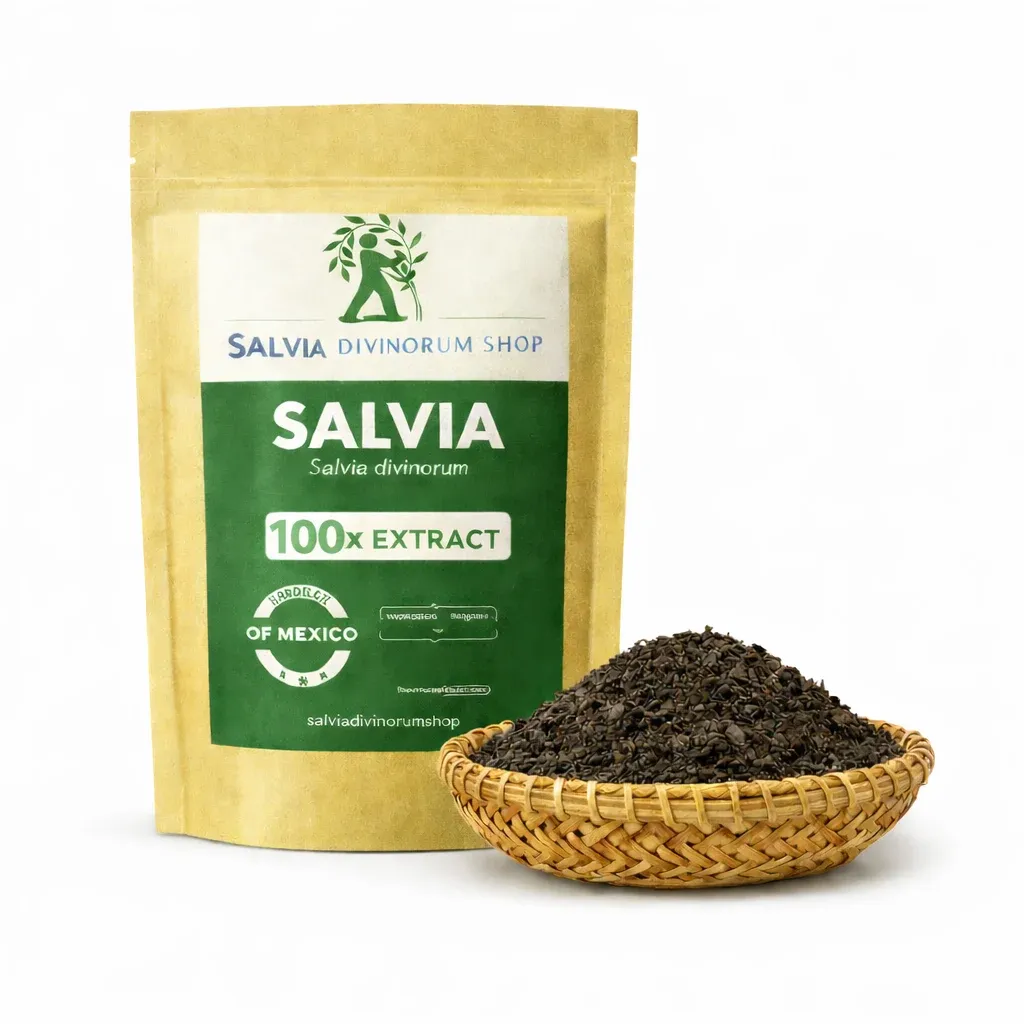
When two botanical products both carry a “100x” label, it is tempting to assume they are essentially the same product and compare them by price.
That approach misses most of the useful information.
A high extract number tells you how the seller positions the product within its range. It does not tell you everything about consistency, quantity, packaging, documentation or the quality of the listing itself.
For anyone comparing 100x salvia extract for sale, a better approach is to look at the entire product page rather than allowing one number to make the decision.
Quick Summary
A useful 100x extract listing should answer six basic questions:
|
Question |
What to Check |
|
What plant is it? |
Clear identification as Salvia divinorum |
|
What product form is it? |
Extract rather than plain leaf or powder |
|
How much is included? |
Clearly stated package quantity |
|
What does 100x mean here? |
Context within the seller’s extract range |
|
How is it presented? |
Useful photos and accurate description |
|
How is it protected? |
Packaging and storage information |
The simplest rule is this:
Treat 100x as one product characteristic, not the entire product description.
Begin With Identity
Before comparing strength, confirm what the product actually contains.
The botanical name should be clearly stated as Salvia divinorum.
This sounds basic, but “Salvia” by itself can refer to many species of sage.
A detailed commercial listing should remove that ambiguity immediately.
The same principle applies to most botanical products: exact identification should come before marketing terminology.
Confirm That You Are Comparing Extract With Extract
The next step is equally simple.
Make sure both listings describe the same type of product.
Salvia divinorum may be offered as:
-
dried leaves
-
powdered material
-
concentrated extracts
-
tincture-style preparations
-
live propagation material
A 100x extract should therefore be compared primarily with another extract rather than with plain dried leaf based on price alone.
Otherwise, the comparison becomes misleading.
What Does the 100x Number Actually Help With?
The multiplier is useful because it gives buyers a way to distinguish products within an extract range.
For example, a seller may organize extracts as:
10x → 20x → 40x → 100x
That structure immediately tells the buyer that the products occupy different stated concentration tiers.
What the number does not automatically tell you is whether:
-
the product description is accurate
-
the package quantity is clearly stated
-
the product is consistently presented
-
the material is packaged properly
-
the seller provides useful supporting information
That is why comparing only the largest number is rarely enough.
Look at the Seller’s Entire Extract Range
One of the fastest ways to evaluate a 100x listing is to open several other extract pages from the same seller.
You are looking for consistency.
Do the different strength pages explain how the products relate to one another?
Or is every page identical except for the number in the title?
A well-organized extract range should make it easy to understand that 10x, 20x, 40x and 100x are separate product categories.
The descriptions do not need to be extremely long.
They simply need to provide enough information to make the distinctions meaningful.
Check Whether Quantity Is Obvious
High-strength products are often sold in small packages.
That makes quantity especially important.
Imagine these two listings:
Listing A: $35
Listing B: $55
At first glance, Listing A appears cheaper.
But if Listing A contains 0.5 grams and Listing B contains 1 gram, the comparison changes.
Always compare:
price + quantity + product type
rather than price alone.
The package amount should be visible without forcing buyers to search through an entire page.
Product Photography Should Support the Description
Photos cannot verify extract concentration.
However, they can still provide useful information.
A good image can help a buyer understand:
-
what form the extract takes
-
its general appearance
-
its texture
-
the type of packaging
-
whether the image appears consistent with the written description
Generic photographs of Salvia leaves are less useful on a page selling concentrated extract because they do not show the product being discussed.
The best photographs support the product description instead of simply decorating the page.
Consistency Across the Page Matters
A good product page should tell one coherent story.
The title, description, photographs, quantity and product options should all agree.
For example, if the title says 100x but the description repeatedly discusses 40x, something is wrong.
If the package size displayed near the price differs from the size mentioned further down the page, the buyer has another reason to ask questions.
These may sound like minor details.
But consistency is especially important when shopping for products where buyers cannot physically inspect the material before ordering.
Packaging Is Part of the Product
Packaging is often treated as a shipping detail.
For dried botanical extracts, it is also part of product handling.
Buyers should look for information about how the material is protected from:
-
moisture
-
contamination
-
unnecessary heat
-
prolonged direct light
The seller does not need to reveal every packaging step.
A short explanation is enough to demonstrate that storage and product protection have been considered.
Clear storage information is equally useful once the product reaches its destination.
Use the “Three Pages” Test
Here is a simple way to evaluate an unfamiliar seller.
Do not judge the store from a single product page.
Open three pages:
Page 1: The 100x extract
Check quantity, photographs, product information and packaging.
Page 2: Another extract strength
See whether the seller clearly distinguishes the two products.
Page 3: Shipping or policies
Check delivery information, restrictions and what happens when an order encounters a problem.
Those three pages usually reveal much more than the homepage alone.
What to Check Before Choosing a 100x Listing
Someone researching salvia 100x extract online can make the comparison easier with this short checklist.
Botanical identity
Does the listing clearly say Salvia divinorum?
Product form
Is the item clearly identified as an extract?
Quantity
Can you immediately see how much is included?
Extract range
Does the seller explain or clearly organize its different strength categories?
Photography
Can you see the actual type of material being described?
Packaging
Is there information about how the product is protected?
Storage
Does the seller provide sensible storage information?
Shipping
Can you find destination, processing and delivery information?
If most of these answers are easy to find, the listing is doing its job.
Don’t Confuse Strength With Overall Quality
This distinction is worth repeating.
“100x” describes one characteristic of the product.
It does not automatically tell you about:
-
freshness
-
consistency
-
packaging
-
description accuracy
-
shipping
-
customer service
-
seller transparency
A lower-numbered extract with clear documentation and consistent presentation may provide more useful information than a higher-numbered product surrounded by vague claims.
The strength label and overall product quality should therefore be evaluated separately.
Watch for These Warning Signs
A few patterns deserve extra attention.
The product description is almost entirely adjectives
Words such as “premium” and “ultimate” should not replace factual information.
Quantity is difficult to find
Buyers should know what the listed price actually includes.
Every strength uses identical copy
Changing only the multiplier does not help explain a product range.
The photos do not show the extract
Generic botanical imagery offers limited information.
Shipping information is missing
Buyers should understand where the product can be shipped before reaching checkout.
None of these alone proves a poor product.
They simply tell you that more information may be needed.
A Better Way to Compare Value
Instead of asking:
“Which 100x is cheapest?”
ask:
“Which listing gives me the clearest combination of quantity, product information, packaging and seller transparency for the price?”
That question produces a much more useful comparison.
It also makes it easier to identify why two products with the same extract designation may have different prices.
FAQ
Is every 100x Salvia extract identical?
No. A shared commercial label does not mean every seller’s product, preparation or documentation is identical.
Should I compare 100x extract directly with plain dried leaf?
Not on price alone. They are different product forms.
Does a higher extract number automatically mean higher overall quality?
No. Concentration and overall product quality are separate considerations.
What information matters most besides the strength label?
Botanical identity, quantity, clear descriptions, useful photographs, packaging, storage guidance and seller policies.
Why should I look at other extract pages from the same seller?
They can show whether the seller maintains a logical and consistent product range rather than simply changing numbers between otherwise identical listings.
Final Thoughts
A 100x label attracts attention because it is simple.
A good buying comparison requires a little more information.
Check the botanical identity. Confirm the product form. Compare package quantity. Look at the seller’s wider extract range. Examine the photographs. Read the packaging, storage and shipping information.
None of those checks takes very long.
Together, they provide a much clearer picture of the product than the extract multiplier alone.
For high-strength botanical listings, clarity and consistency are often the most useful signals a buyer can evaluate online.
